
Like many others, I have gone through that frustrating moment. I put my soul, time, and money into building a great platform. Then, though many website visitors came there, they hardly purchased anything and did not subscribe to the e-form. Whatever I tried, nothing worked the way it had to, without any clue. Let me share a transformative experience that completely changed my approach to Conversion Rate Optimization.
Once, after reviewing a blog’s user experience to understand why, one of my friends asked me why, despite high traffic, very few visitors were subscribing to its newsletter. The problem? Out of immediate view, the newsletter sign-up form was buried at the bottom of the page. However, with the power of CRO, we were able to turn the situation around, bringing a sense of relief and satisfaction.
Was that the only problem? No! Moving the form to the top of the page wouldn’t create a better experience. After delivering relevant and engaging content, I repositioned the form in the middle of the page. I replaced the “Submit” button text with “Join Us.” What happened? More than a 25% increase in newsletter subscriptions!
More affectionately known as Conversion Rate Optimization or CRO, this approach encompasses turning the run-of-the-mill visitor into a power user. Beyond fundamental changes, CRO focuses more on optimizing a site for users’ experience by creating more opportunities to engage a viewer, establish trust, and ensure customer loyalty. Whether you operate a small online store or oversee a large platform like Uber or Amazon, CRO is a crucial element of your growth plan.
What is the conversion rate?

The conversion rate describes the number or percentage of customers accessing the website and performing actions foreseen by them, such as ordering goods, subscriptions, and downloading PDF files.
You will have a clear roadmap for improving conversion rates, enhancing user experience, and maximizing revenue. Let’s embark on this journey together!
It reflects how effectively users connect with your goals and reveals the vitality of your digital presence.
The conversion rate can be the percentage at which website traffic or visitors initiate an action, such as buying a particular product, subscribing to newsletters, or downloading PDFs. It is not a number but how effectively users interact with your goals.
Let me share a little experience. Some five years ago, I made an e-commerce website for sporting equipment. The site received massive traffic; many people visited it, yet few customers bought goods. Until then, the conversion rate isn’t just any percentage but was more of an insight into what metrics users enter with your website and how effective those pages may guide them through.
In other words, conversion rate answers the fundamental question: Is this part of your website working for your users?
Why Conversion Rate Matters?
Just as a healthy heart is vital for human survival, monitoring the conversion rate is essential for the survival of startups.
Imagine hosting a weekend party and having 99% of your guests leave right after they arrive because they didn’t enjoy it. That would suck, right? You’d try to find out what went wrong and fix it, or you think you have lousy guests, which would be the wrong conclusion!
The same applies to websites and apps. If 1,000 users visit your website but only 10 make a purchase, your conversion rate is 1% (10 divided by 1,000).
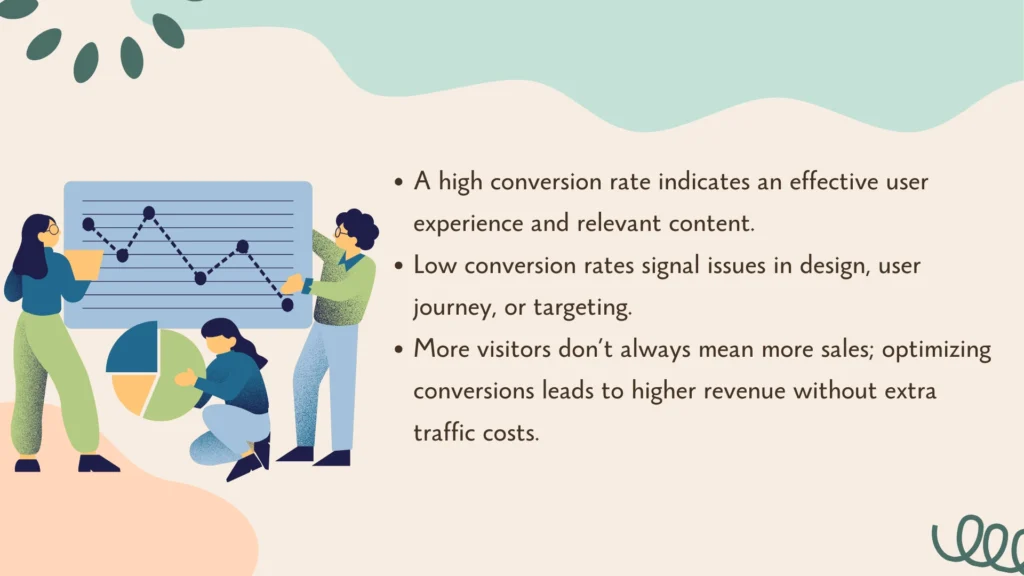
A high conversion rate is a good sign! It means your audience resonates with your content and finds what you offer relevant. Therefore, you should give them more of the same.
However, a low conversion rate indicates a problem. It means your website’s design or user experience needs improvement, as it does not yield the desired results.
Some might ask, “Isn’t traffic more important?” The answer is simple: Marketing experts say, “Millions of visitors without sales are worthless.”
More sales, sign-ups, and downloads- without spending extra on traffic; that’s the power of focusing on Conversion Rate Optimization!
Don’t make this mistake in CRO!

One of the businesses’ most significant mistakes is assuming they know what works for their users. You might think, “This button looks better here” or “This call-to-action should work,” without having actual user data. But once you start leveraging user data, you’ll be amazed at the insights it can provide.
The biggest mistake businesses make is assuming what works for their users. You might say, “This button looks better here” or “This call-to-action should work,” without having actual user data. But once you start leveraging user data, you’ll be amazed at the insights it can provide. To understand which version of the whole webpage or elements within it performs well, you’ll have to rely on A/B testing. This methodology involves taking two webpage versions or elements and testing which has higher yielding results. It’s the process of making effective decisions through data, from analyzing user interactions with your website to creating enhancements in conversion rates.
A/B Testing for CRO
To understand which version of the whole webpage or elements within it performs well, you’ll have to rely on A/B testing. This methodology involves taking two webpage versions or elements and testing which has higher yielding results. It’s the process of making effective decisions through data, from analyzing user interactions with your website to creating enhancements in conversion rates.
It is incredible, but many companies waste an enormous budget because they don’t optimize their conversion rates. CEOs complain about low sales, and product managers and UX designers work hard to discover why users don’t convert. A step-by-step CRO guide will focus on the right metrics, such as bounce rate, average session duration, and conversion rate, and run meaningful tests to save them from wasting so much time and money.
Minor adjustments can result in substantial sales and cultivate loyal, long-term customers. By the end of this actionable guide, you will be crystal clear about increasing conversion rates, improving user experience, and boosting your bottom line. Let’s begin our journey!
Who Owns Conversion Rate Optimization in a Team?
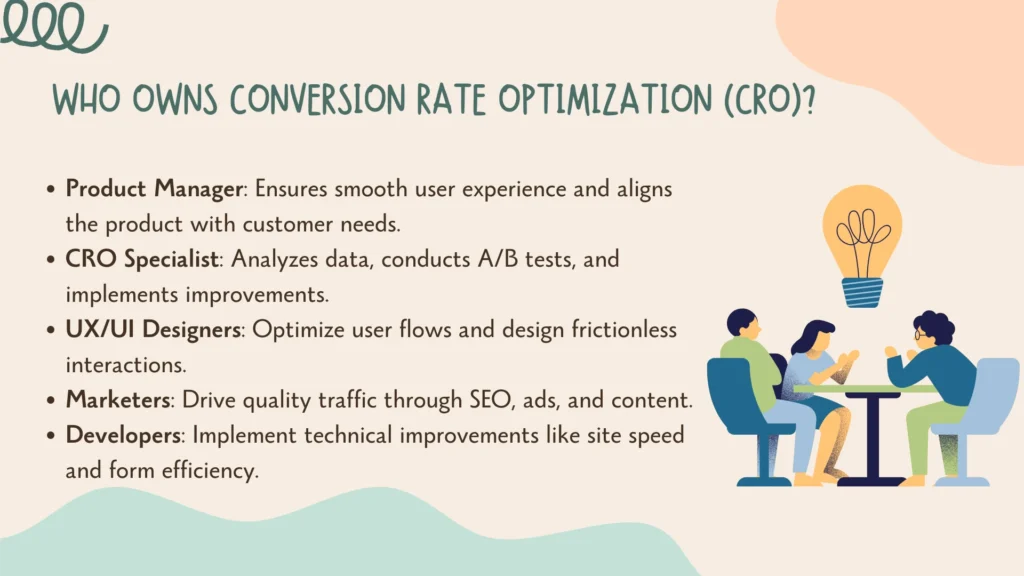
Conversion Rate Optimization was a critical assignment for the startup team, requiring multiple key roles to improve. But who owns this directly?
1. Product Manager
The Product Manager optimizes user experience and customer journey analysis and aligns the product according to user needs.
2. CRO Specialist (Conversion Rate Optimization)
If the team resources allow, this is where the CRO specialist does the heavy lifting: analyzes data, conducts A/B testing, and communicates actionable insights to improve the conversion rate.
3. UX/UI Designer
UX and UI designers optimize user flows and interactions to reduce friction in the conversion process.
4. Digital Marketers
Marketers drive the right audience to the site through ads, content, and SEO to get more qualified leads.
5. Developers & Engineers
Technical teams implement improvements in web speed, form functionality, and other suggestions by the CRO for better results.
Conversion rate optimization involves every single one within a startup, but by tradition, a Product Manager or CRO Specialist will usually oversee the monitoring process and the execution of optimizations. The key is collaboration across groups.
How Can You Improve Your Conversion Rate?
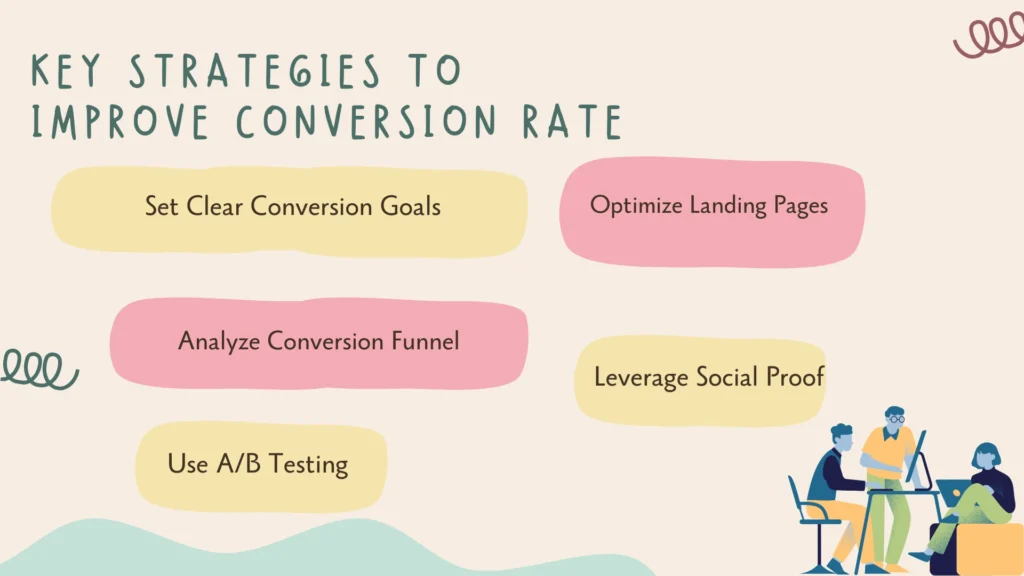
As we already know, the person responsible for Conversion Rate Optimization is responsible for the second most important question: How can one effectively enhance conversion? Optimizing conversion requires a data-driven approach, constant testing, and strategic improvement.
10 Effective Conversion Rate Optimization Strategies
1. Determine Your Site or App’s Conversion Goal
A reasonable conversion rate is not the same for every business. Depending on your site or app, you should set a conversion rate goal that makes sense for your website or app. Here are some examples illustrating conversion goals for different sites and apps. But again, these are just examples. You’ll want to establish your own conversion goals that reflect your business.
- Real Estate Platform:
Goal: This is to have the user book a viewing for the property.
Example: On this website, one click gives an appointment to view the property.
- Dental Booking Platform:
Goal: How easy is it to book an appointment?
Example: This online platform lets users book an immediate dentist appointment with only a few clicks.
- News Platform:
Goal: Newsletters or subscription sign-ups.
Example: A news website, for instance, gives value-added articles only to its paid members.
- Food Delivery Apps:
Goal: To have the user make an order.
Example: The application offers a discount on the first order to persuade users to purchase.
- Online Learning Platforms, Course or subscription sales:
An online learning platform might offer special discounts when buying many courses at once to encourage sales.
- Gaming Platforms:
Incentivize to download or make in-app purchases. Example: A game would show attractive attributes and allure consumers to download.
Objective: To create an account or request a loan.
Example: Opening an account can be quick and easy using a banking app.
2. Analyze the Conversion Funnel
The conversion funnel shows users’ steps through your site before they complete the desired action. Analyzing these steps will help you pinpoint where the users drop off, guiding you in improving those areas.
For example, in one project, we realized that users left the product page for a sports T-shirt without clicking the “Add to Cart” button. Adding customer reviews, a product video, and a size guide, and changing the look and feel of the “Add to Cart” button lowered the exit rate on this page by 47%.
Pro Tip:
Visualize your conversion funnel using tools such as Google Analytics or Skippership. Identify pages with high exit rates and test modifications on those pages.
3. Employ Clear and Consistent CTAs
The buttons must be very noticeable and transparent about what action to take next. The user should not have to think about the following action.
Example: A movie subscription website like Netflix had a CTA that said, “Click Here.” We changed it to “Get Your Free Trial Now,” which made 30% more people interested in watching movies and shows.
Pro Tip:
Put your calls-to-action in attention-receiving positions; their button color should contrast with the background. The shade used should also feature within the principal color scheme. Run tests to find the combination that performs well with target segments and copy. Tools that provide heat mapping and session recording can help explain what is hot.
4. Optimize Landing Pages for Conversion Rate Optimization
Your landing page is the gate through which most conversions will arrive. It is supposed to foster trust in your product, though not at once, while immediately highlighting its feature set. Yet, it shall not distract the attention of sending users from their intended action:
This month, we tried some simple adjustments: adding a short product video to the landing page and reducing the number of fields in the sign-up form; this increased SaaS platform conversions by more than 50%.
Pro Tip:
Your key pages should always be simple and mark the last point of the customer’s journey. Missing the mark means no conversions whatsoever. Avoid intricate animations that would make users spend much time on other things. In turn, you should show all the essential features of your product on this page.
5. Highlight Social Proof
If some customers review or rate you on social media or any other website, showcase such reviews on your website. That would build trust and enhance the rate of conversion. You build user confidence this way. If your app or platform reviews are being listed on some other websites like G2 or Trustpilot, make it a point to feature them on your website.
Example: For one of my clients, adding customer reviews to the pricing page reduced cart abandonment by 15%.
Pro Tip:
Place customer reviews near or around your calls-to-action buttons, preferably on the price page. Use real people’s names along with their real photos to keep it as realistic and trustworthy as possible.
6. Test and Repeat for CRO
CRO is an ongoing process; you can’t optimize once and let things fall where they may. Run A/B tests, which enable you to experiment with design variations, copy, and layouts.
Example: I once ran an experiment on a sports equipment website, which showed that having an actual mannequin represent the product increases sales by 10% compared to an animated version.
Pro Tip:
You begin by making subtle changes to the buttons or titles. After a few days, you are to review the outcomes. We will then proceed with some major revisions to the page layout, moving the positions of the forms and adding videos to the product pages.
7. Make forms more efficient for Conversion Rate Optimization
Lengthy forms will discourage visitors from finalizing their purchases. Forms should be kept short and only include information that is absolutely necessary.
Example: I decreased the number of fields in a sign-up form on a movie subscription website from 10 to 5. This increased the website’s sign-up rate by 50%; eventually, user purchases rose by 12%.
Pro Tip:
If your forms are long, use multi-step forms. Also, always add a reassurance message, like a checkbox that says, “We will never share your email information.”
8. Implement Pop-ups for CRO
Pop-ups can attract users to your website or application. When a user is about to leave your website, upping the ante with a great deal may help convince them to continue the journey with you.
Example: Let’s say the customer intends to leave your product page. To redirect them to the website, offer 10% off or a coupon code.
Pro Tip:
Offer something of value, such as a discount code, a free PDF, or a 14-day trial account.
9. Responsive design
Since people now access the web using mobile phones, your website must function well across all devices.
For example, I once had to work on a project where the mobile checkout page wasn’t responsive. After optimizing for mobile, we fixed it and noticed a 35% increase in product purchases.
Pro Tip:
Test your site on desktop, mobile, and tablet. Use session recordings from tools like Skippership to understand how your users see your site on different screen sizes.
10. Personalization of User Experience for Conversion Rate Optimization
Sometimes, giving them a feeling of being special, such as control over their homepage or dashboard, does the magic. For example, if you have provided a dashboard, give them tools to help users customize it to suit their needs instead of forcing a fixed design on them.
Example: One trading app allowed users to move blocks around their dashboard. This feature increased the share of users who stayed with the application by more than 20%.
Pro Tip:
Never overwhelm them with choices; always provide a default structure or suggest some options before letting the user customize. For example, Trello provides initial templates for task management and allows users to move them around.
Conclusion
In other words, CRO is turning website visitors into loyal customers by improving their website experience. You can increase conversions without extra marketing costs by making changes, running A/B tests, and sticking with what works. Whether it be e-commerce or SaaS, CRO is key to growth. The main focuses are website design optimization, call-to-action buttons, forms, mobile experience, and the use of social proof. Regular testing and teamwork will help with continuous improvement.
FAQ
1. What is CRO?
CRO is improving your site or app to increase the number of users who complete a desired action.
2. Why is CRO important?
It boosts results from existing traffic without extra marketing costs.
3. What counts as a conversion?
Any key action like purchases, sign-ups, or downloads.
4. How to calculate the conversion rate?
(Conversions ÷ Visitors) × 100.
5. What are common CRO strategies?
A/B testing, faster pages, better CTAs, and simpler forms.
6. How to know what to optimize?
Use analytics, heatmaps, and user feedback to find weak points.
7. How long to see CRO results?
Usually within a few weeks after testing and updates.
8. CRO vs. SEO?
SEO brings traffic; CRO turns that traffic into actions.
9. Can small businesses use CRO?
Yes, even minor improvements can have a significant impact.